Copyright Office confirms January 5 fee increases
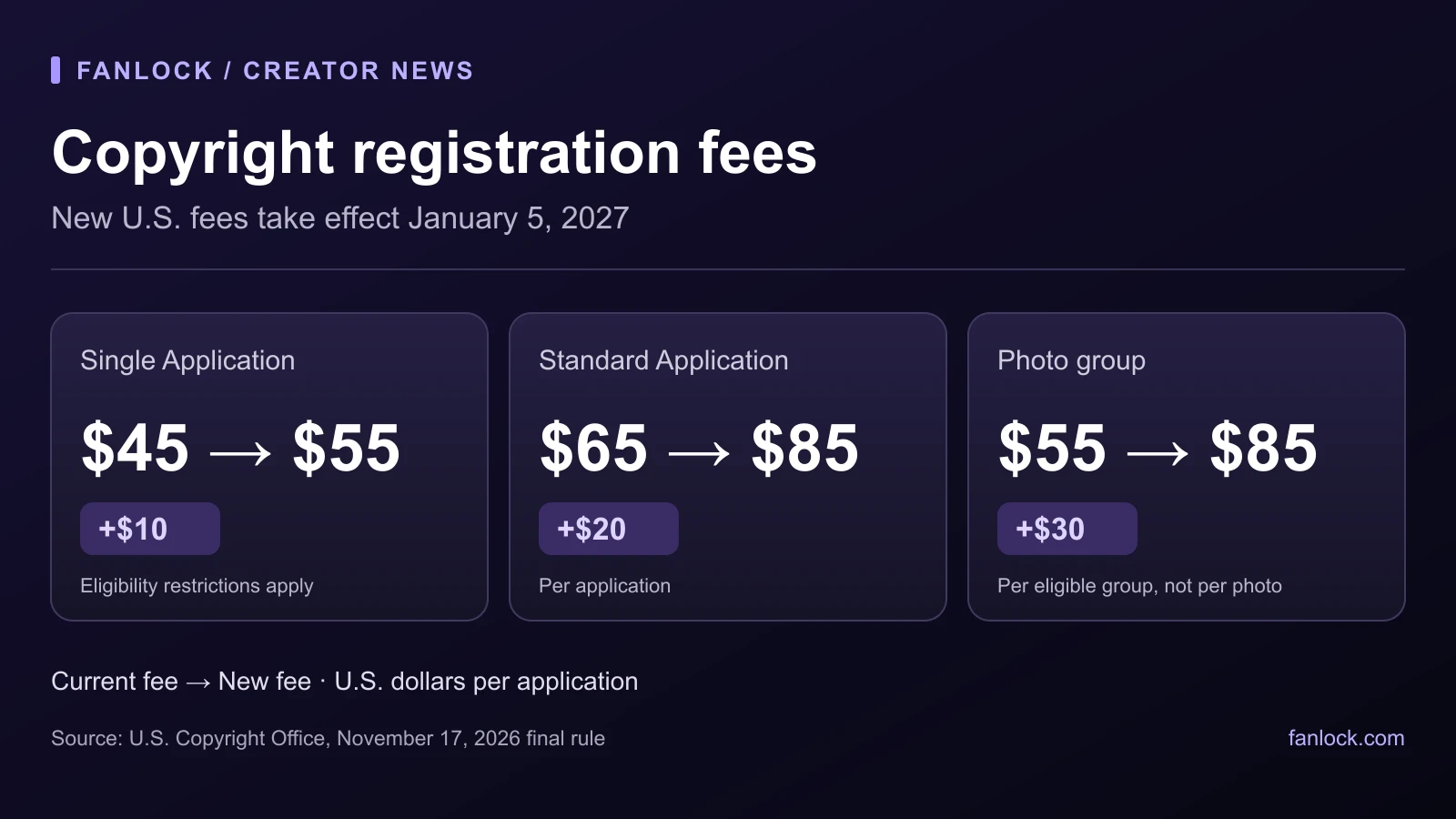
The U.S. Copyright Office announced a final rule on November 17 that raises several registration fees from January 5, 2027. Creators will pay $85 for a Standard Application, up from $65. The fee for an eligible group of photographs will rise from $55 to $85. Copyright Office announcement.
This is the Office’s first general fee-schedule adjustment since 2020. It says inflation and higher operating costs prompted the changes. The increases affect registration and other Office services, including record searches and recordation. Fee study and final rule.
For creators budgeting to register photos, videos or other work, the relevant cost depends on the application they qualify to use. A creator who finds an unauthorized copy online can still send a DMCA notice without first paying a registration fee.
Copyright registration fees: current rates and January 2027
| Application | Current fee | From January 5, 2027 | Increase |
|---|---|---|---|
| Eligible Single Application | $45 | $55 | $10 |
| Standard Application | $65 | $85 | $20 |
| Group of published or group of unpublished photographs | $55 | $85 | $30 |
| Group of unpublished works | $85 | $130 | $45 |
U.S. dollars per application. Each registration option has eligibility requirements; a group fee is not a price per individual work. Sources: current fee schedule and adopted fee schedule, final rule.
The lower-cost Single Application remains available
The Office considered eliminating the Single Application but retained it after reviewing public comments. Its fee will rise by $10 to $55. This option covers one work by one individual author who is also the sole claimant, provided the work is not made for hire. Creators should check those conditions before choosing it because it costs less. Final rule, page 20.
Photo groups can reduce the cost per image
Under the current group-photo rules, an eligible application can cover up to 750 photographs. The group must share the same author and copyright claimant, and contain either published or unpublished photographs. For a published group, all photographs must have first been published within the same calendar year. Copyright Office Circular 42.
The new $85 fee applies to the eligible group. For example, four qualifying photo-group applications would cost $340 under the new schedule, compared with $220 at today’s rate. That is an additional $120 in government filing fees for the same four applications.
Agencies should check authorship and ownership before combining a roster’s work. The Office requires a copy of each photograph and a list of titles and filenames. Videos cannot go into a photo-group application, and the Office treats publication as a legal classification: public display alone does not establish publication. Photo-registration requirements.
Do creators need registration to send a DMCA takedown?
No. Copyright registration is not required before sending a DMCA takedown notice. The Copyright Office confirms that the copyright owner, or someone authorized to act for the owner, can send the notice. Its registration fees do not create a new government fee for reporting a leak. Copyright Office takedown FAQ.
A valid notice still needs the required information, including identification of the original work and the suspected infringing material, contact details, a signature, and the required statements about authorization and accuracy. Save the exact URLs and the records supporting your rights before filing. Notice requirements.
Registration serves a separate purpose. Copyright generally begins when someone creates and fixes an original work, while registration provides a public record and can affect enforcement in court. For U.S. works, registration is generally required before an infringement lawsuit. Copyright Office registration FAQ.
Review your records before choosing a filing date
Creators and agencies can use the fee change to review their registration budgets and catalogues. Keep original files together with authorship records, ownership agreements and publication details. Match each planned submission to an eligible application type before calculating its cost.
Registration timing can affect eligibility for statutory damages and attorney’s fees in federal infringement cases. Section 412 generally limits those remedies when infringement starts before registration, with an exception for registration within three months after first publication of a published work. A creator facing an existing infringement dispute should get advice on those dates rather than plan around the fee change alone. 17 U.S.C. § 412.
For the reporting process, see our guide to filing a DMCA takedown for leaked creator content.
Sources and reporting notes
Prepared November 17, 2026, U.S. Eastern time. Fanlock checked the announcement and adopted fees against the Copyright Office’s November 17 final rule, available in its public-inspection version. The new fees take effect January 5, 2027. The four-application example is Fanlock’s calculation. Featured graphic: Fanlock, using the Office’s current and adopted fees.
- Copyright Office: November 17 announcement — Announcement date and January 5, 2027 effective date.
- Copyright Office: 2026 fee study — Rulemaking history and links to the final schedule.
- Final rule: Copyright Office fees — Adopted fees and retention of the Single Application.
- Copyright Office: Current fees — Existing fees before the January 2027 change.
- Copyright Office: Registration of photographs — Photo-group eligibility, publication and submission requirements.
- Copyright Office: Section 512 notice-and-takedown FAQ — Registration is not required to send a takedown notice.
- Copyright Office: Copyright in general — Automatic protection and the role of registration.
- 17 U.S.C. § 412: Registration and certain remedies — Timing rules for statutory damages and attorney’s fees.
About Mia Esperansa
Editorial at Fanlock
Mia Esperansa is part of Fanlock’s editorial team.
Published by Fanlock. Editorial standards and corrections