Which DMCA service recorded the most Google delistings per creator?
Fanlock had the highest average number of recorded removed Google Search URL entries per creator in this sample, followed by BranditScan, Ceartas, Bruqi and Rulta. The chart compares the same request-filing window across these services.
This is an analysis by Fanlock, one of the services compared. It measures Google Search delisting records, not deletion from the websites hosting the content. It is not an independent ranking by Google or a test of every service’s overall effectiveness.
Throughout this report, averaged per creator means removed URL entries divided by normalized copyright-owner names in the reporting window. That is a proxy for comparison, not a count of verified customers or individual people. The methodology below explains the limits.
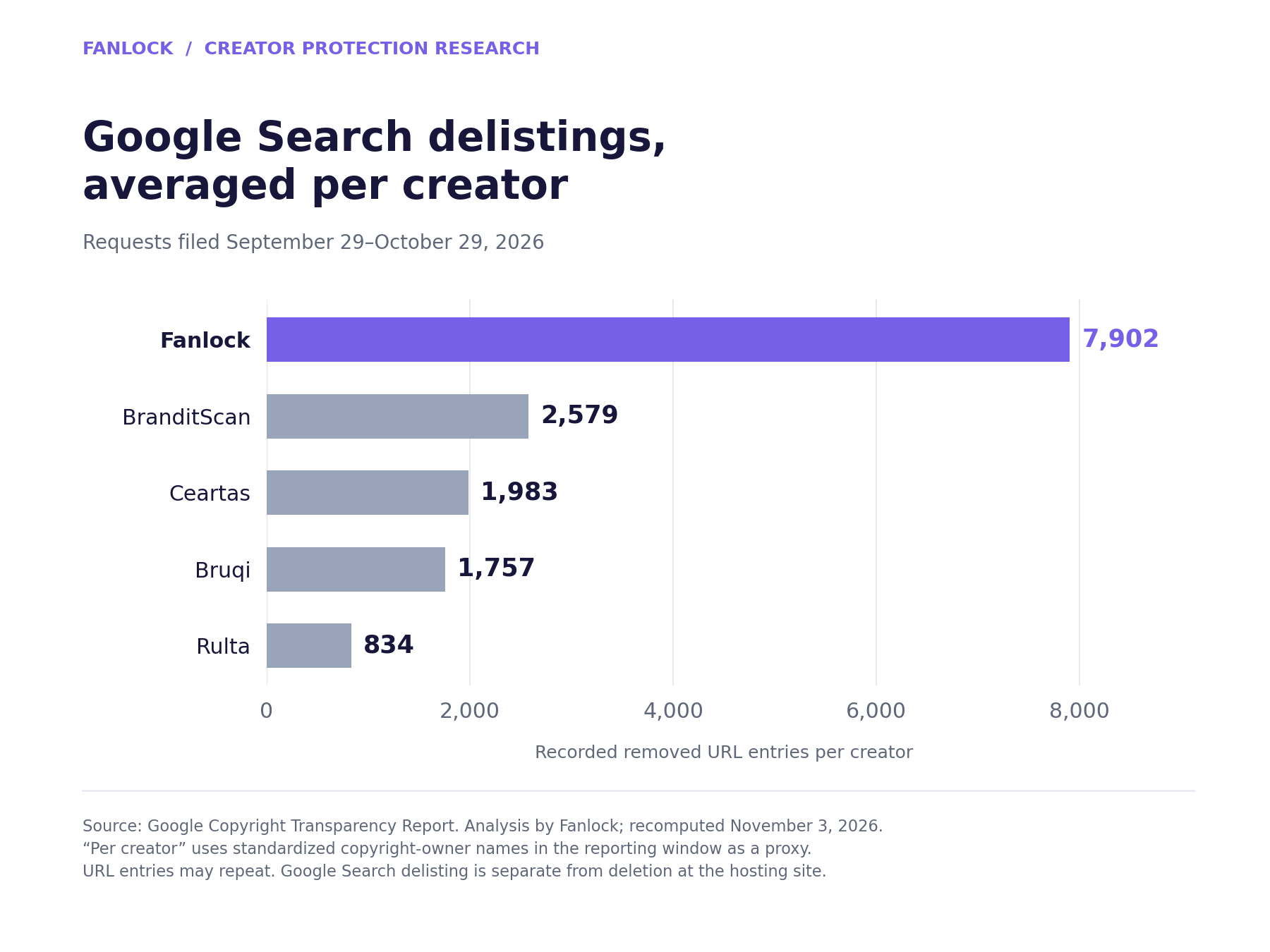
Google delistings averaged per creator: chart data
The bars run from the highest to the lowest recorded average. These values cover requests filed September 29–October 29, 2026, ending at 01:57:39 UTC; the analysis was recomputed November 3, 2026.
| DMCA service | Recorded Google delistings, averaged per creator |
|---|---|
| Fanlock | 7,902 |
| BranditScan | 2,579 |
| Ceartas | 1,983 |
| Bruqi | 1,757 |
| Rulta | 834 |
Rounded to whole URL entries. “Per creator” uses normalized copyright-owner names as a proxy, not verified customers. Repeated URLs can be included. These are Search delistings, not host deletions or overall effectiveness scores. Methodology and limits.
What do the Google submission outcomes mean?
A submission is a request for action. Its recorded outcome tells you what happened to that URL entry in Google’s reporting data. Read these categories separately when comparing a DMCA service for content creators.
- Removed from Search: Google records the URL entry as removed from its Search results. The content may still exist at its original web address.
- Not indexed: The URL was absent from Google’s Search index. Google still processes these notices to prevent the URL appearing in Search later. This category does not establish a failed or inaccurate request.
- No action: The data records no removal action for that entry. There can be different reasons, so this category alone does not explain why Google did not act.
- Pending: The snapshot does not yet record a final outcome. Later processing can change the result.
Google explains these categories and the scope of its reporting in its copyright-removal transparency FAQ. The charts below include pending entries in the submitted total; they are not success rates calculated only from completed decisions.
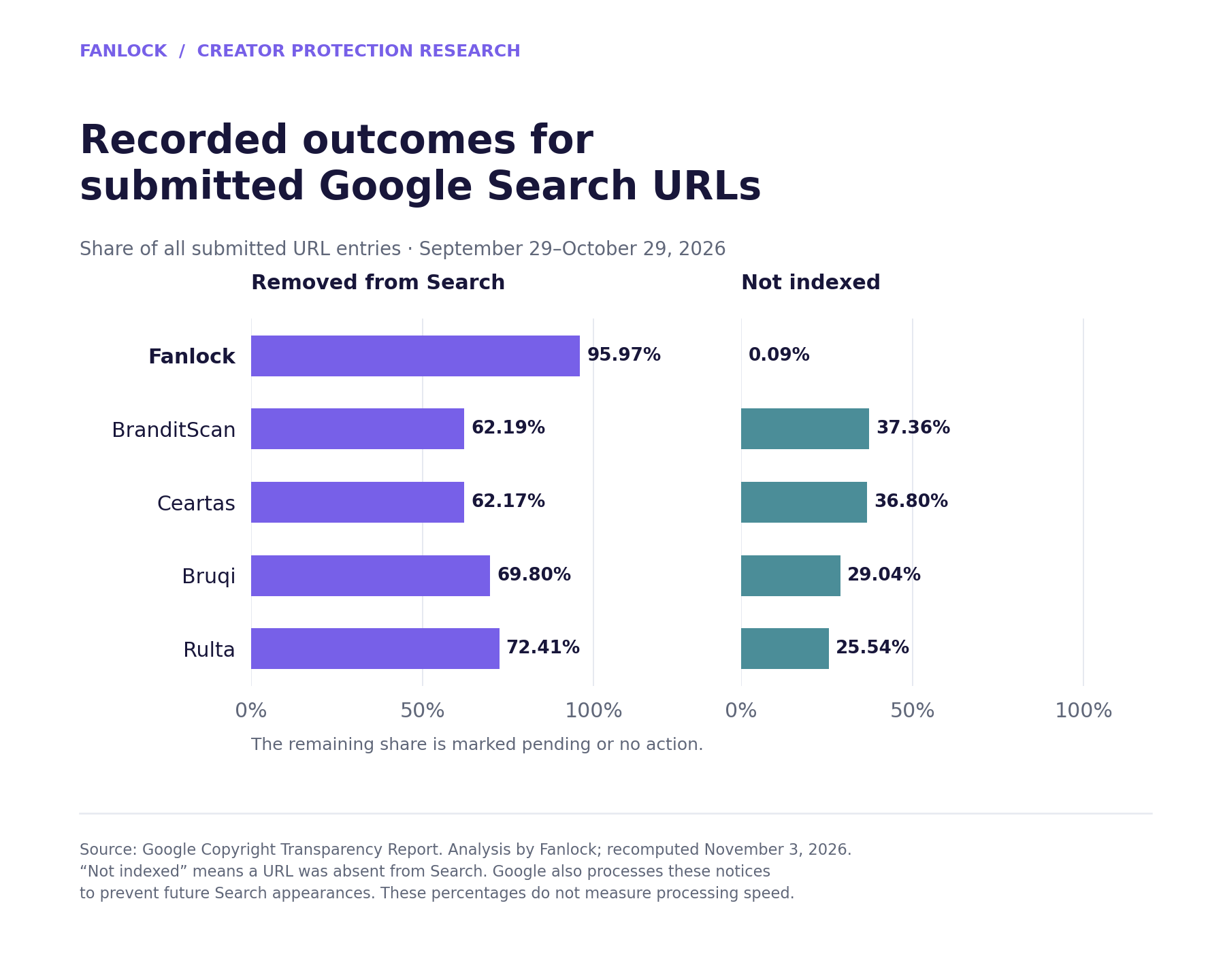
Recorded Google submission outcomes: chart data
Each percentage uses all submitted URL entries for that service, including pending entries. The remaining share is pending or no action. The chart and table use the same September 29–October 29 request-filing window.
| DMCA service | Removed from Search | Not indexed |
|---|---|---|
| Fanlock | 95.97% | 0.09% |
| BranditScan | 62.19% | 37.36% |
| Ceartas | 62.17% | 36.80% |
| Bruqi | 69.80% | 29.04% |
| Rulta | 72.41% | 25.54% |
Percentages are rounded to two decimal places. A not-indexed result means the URL was absent from Search; it is not a measure of a failed request, accuracy or speed. Source: Google Copyright Transparency Report; analysis by Fanlock. Download the provider comparison CSV.
Fanlock’s submitted URLs, broken down by outcome
The next chart shows Fanlock’s complete submitted total in this window, including removed, not indexed, no action and pending entries. Keeping all categories visible makes the denominator clear.
These are URL entries in the reporting data. Repeated submissions can appear in the total, so it should not be read as a count of unique leaked photos, videos or pages. The chart records the snapshot used for this report; it is not a live dashboard.
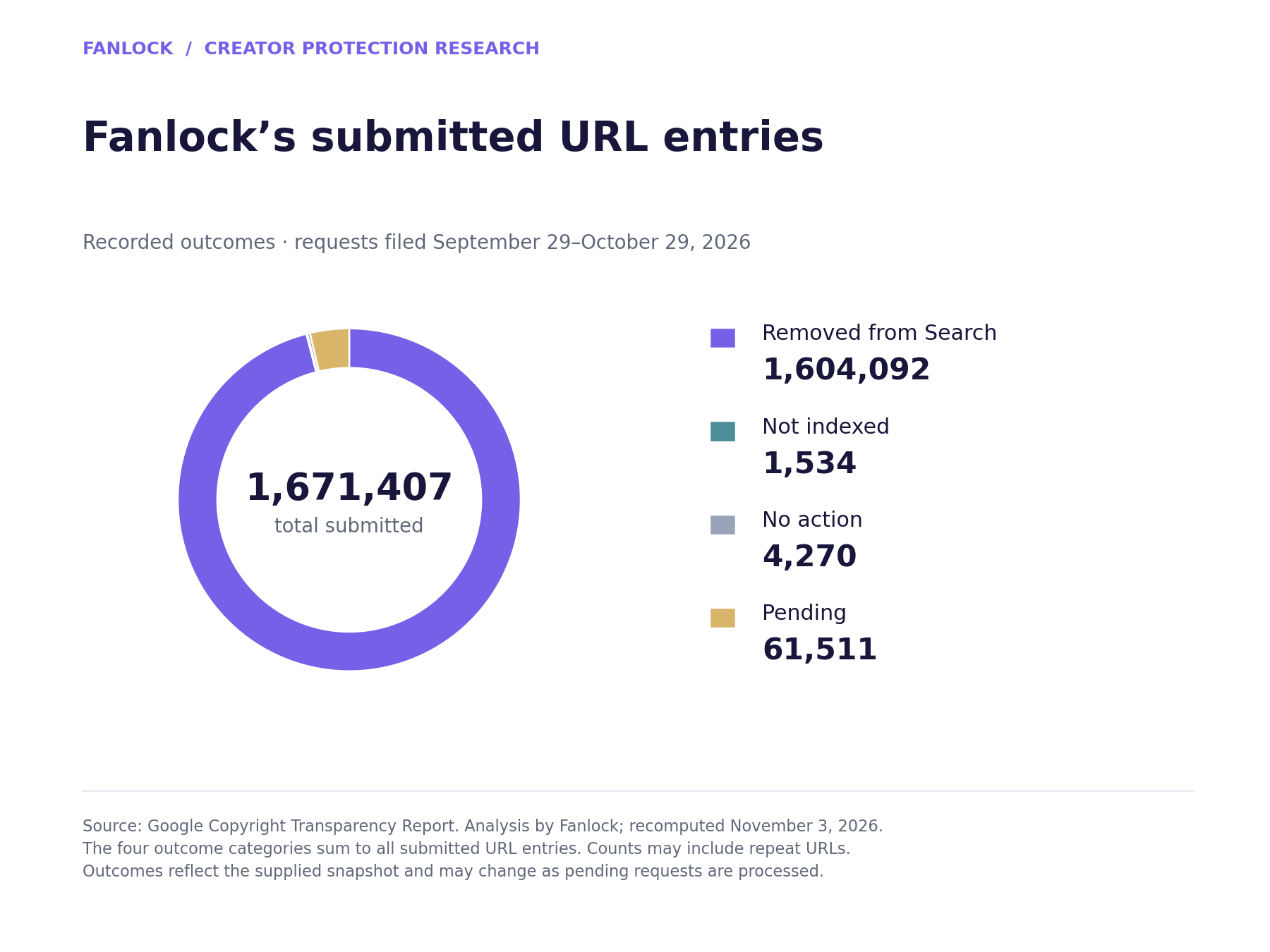
Fanlock’s recorded URL-entry counts: chart data
The four categories below add up to every submitted URL entry shown in the chart. Pending entries remain in the total.
| Recorded outcome | URL entries |
|---|---|
| Removed from Search | 1,604,092 |
| Not indexed | 1,534 |
| No action | 4,270 |
| Pending | 61,511 |
| Total submitted | 1,671,407 |
Requests filed September 29–October 29, 2026; analysis recomputed November 3, 2026. Counts may include repeated URLs and can change as pending requests are processed. Download the Fanlock outcome CSV.
How to choose the best DMCA service for content creators
Use this report to ask better questions about a leak removal service. Your choice also depends on where your content is being reposted, what the plan covers and whether you can see what happens after a report is sent.
- Check coverage against your actual leaks. Ask which search engines, websites and social platforms the service monitors, and which accept manual reports. A Google Search comparison cannot establish coverage elsewhere.
- Separate Search delisting from source removal. Ask whether the service sends requests to the site or host as well as to Google. Get a clear explanation of what each status in your dashboard means.
- Ask for outcomes, not just submission volume. Look for reporting that separates removed, not indexed, no action and pending. Ask whether totals count repeated URL submissions.
- Ask how reuploads are handled. Find out whether monitoring continues after a removal and how to report a new copy or URL.
- Check the plan and your part in the process. Review scan frequency, reporting limits, supported identities, price and cancellation terms. Ask what authorization and evidence of ownership you need to provide.
A higher removed-URL average is a finding about this dataset. It does not by itself prove that a service is faster, more accurate or the best fit for every creator. For plan details and reporting workflows, read our Rulta review, BranditScan review and Rulta, BranditScan and Fanlock comparison.
Methodology: dates, attribution and limits
Source and window. Fanlock analyzed Google Copyright Transparency Report bulk records for requests filed from September 29, 2026 through October 29, 2026 at 01:57:39 UTC. The analysis was recomputed on November 3, 2026. The window selects requests by filing date; it does not establish that every recorded removal happened during those dates.
Service attribution. Reporting-organization records were grouped under Fanlock, BranditScan, Ceartas, Bruqi and Rulta using their names and documented attribution. BranditScan’s own website links its Google delisting statistics to reporter 360291, listed as DMCA Piracy Prevention Inc. That website-to-reporter link was checked on November 5, 2026. The BranditScan grouping also includes records explicitly named BranditScan and normalized variants of DMCA Piracy Prevention Inc.
Averaged per creator. For each service, recorded removed URL entries were divided by the distinct normalized copyright-owner names appearing in the window. Names were standardized with Unicode NFKC normalization and case folding, retaining letters and digits. Unknown names used an explicitly marked owner-ID fallback. Names can represent entities, vary between notices or refer to the same person under different identities. This denominator is a proxy, not a verified customer count.
Outcome shares. Each outcome count was divided by all submitted URL entries for that service, including pending entries. Averages are rounded to whole entries; percentages are rounded to two decimal places. The Fanlock breakdown shows the underlying outcome counts.
Limits. The services represent different creator populations, leak exposure and filing practices. This is not a matched comparison of the same creators using every service. Google’s data can include duplicate requests, and the figures count URL entries rather than unique files. They do not measure host deletion, removal speed, revenue protected, customer satisfaction or activity outside the Google reporting data. Pending outcomes can change after the snapshot.
Disclosure. Fanlock prepared and published this report and is included in the comparison. Google supplies the public reporting data; Google has not endorsed this analysis or ranked these services.
Content creator leak-removal questions
Does a Google delisting remove leaked content from the internet?
No. It removes the URL from Google Search results. The original page or file can remain accessible through a direct link or another route. Removing the source copy requires action by the website, platform or host holding it.
Does this report identify the best DMCA service for every creator?
No. Fanlock leads the recorded removed-URL average in this sample, but the report covers one request-filing window and Google Search records. Compare coverage, source-removal support, monitoring, reporting and plan terms against your own needs.
Is a not-indexed result a failed DMCA request?
Not necessarily. It means the URL was absent from Google’s Search index. Google processes these notices to help prevent later Search appearances. A not-indexed share alone cannot establish a provider’s accuracy or processing speed.
What should I do when I find leaked content?
Save the exact URL and enough evidence to identify your original work. Check whether you are seeing a Search result, a hosted copy or both. If you use a leak removal service, submit the URL through its reporting process and track the outcome for each destination. See our DMCA takedown guide for the information a copyright notice needs.
Sources and reporting definitions
The charts use Google’s public reporting data. The linked documentation explains its scope, categories and duplicate-request policy.
- Google Copyright Transparency Report — Public copyright-removal reporting and bulk data.
- Google: copyright-removal transparency FAQ — Outcome categories, reporting organizations, copyright-owner names and data limitations.
- Google: duplicate requests in reporting data — Why repeated requests can appear in the reported totals.
- BranditScan website — The service’s Google delisting link identifies reporter 360291, DMCA Piracy Prevention Inc.; checked November 5, 2026.
Download the chart data and research graphics
These downloads contain the aggregate values already displayed in this report. Averages are rounded to whole entries, percentages to two decimal places, and Fanlock’s outcome counts are exact. They are not the underlying notice-level dataset or a live feed. Read the methodology and limits when comparing or citing the figures.
Provider comparison CSV · Fanlock outcome counts CSV · All published chart data and definitions (JSON)
Average delistings chart (PNG) · Submission outcomes chart (PNG) · Fanlock outcome breakdown (PNG)
When referencing a chart, identify Google Copyright Transparency Report as the underlying source and Fanlock as the analyst. Include the request-filing window and link to this report so readers can check the definitions and limitations.
Cite this research
Fanlock. (2026, November 5). DMCA services for content creators: Google delisting report. Analysis of Google Copyright Transparency Report data for requests filed September 29–October 29, 2026 (through 01:57:39 UTC); recomputed November 3, 2026.
Permanent report URL · Methodology · Download the citation (TXT)
Google supplies the public reporting data; Fanlock prepared this analysis and is included in the comparison. Google Search delistings are separate from source deletion, and Google has not endorsed the report or ranked these services.
Explore Fanlock’s leak removal service for content creators
See how Fanlock’s content protection works, review the coverage and plans, and decide whether it fits the leaks you need help removing.
Published by Fanlock. Editorial standards and corrections